This year brought significant changes to the electricity market. Cost planning has become more complex than ever for business managers. Starting in early 2026, new fees were added to Estonian electricity bills, and these drive up the final price.
The state-mandated security-of-supply fee is now 0.758 cents per consumed kilowatt-hour. Additionally, the balancing capacity fee, resulting from joining the European frequency band, adds another 0.373 cents. These fees apply whether you are buying from or selling to the grid. Consequently, final price calculations are now much more multilayered.
The first few months of the year highlighted extreme electricity price volatility. In this environment, choosing a fixed electricity package seems like the most logical step. However, the economic reality paints a completely different picture. The real question is whether a fixed-price package should be treated as an insurance policy, and how much you are truly willing to pay for it.
Do Fixed Electricity Packages Offer True Security?
Electricity sellers constantly forecast the market and assess risks. To protect themselves against unfavorable scenarios, like high exchange prices during periods of low renewable energy production, they add a hefty risk margin to their fixed packages.
While a company manager wants to ensure predictable input costs, signing a fixed contract often means buying an expensive insurance policy. This policy simply covers the unhedged risks of the energy seller.
A long-term contract locks in the base electricity rate. However, it offers absolutely no protection against the new national surcharges. These fees apply, without exception, to every single unit purchased from the grid. Furthermore, a fixed contract strips the company of the opportunity to save money during periods of zero or negative market prices.
Choosing a fixed package provides peace of mind against sudden price spikes, but the average Nord Pool market rate is usually cheaper. When calculating the annual results, buying electricity through a fixed package will very likely prove to be the more expensive option.
The Main Drawbacks of Long-Term Contracts
-
Expensive Risk Margins: You are covering the energy producer’s risks at the expense of your own company budget.
-
Unavoidable Surcharges: New state fees automatically make every unit taken from the grid more expensive, regardless of your fixed rate.
-
Missed Market Opportunities: Your company cannot benefit from the increasingly frequent hours when electricity prices drop close to zero.
Investing in a Solar and Battery Park Returns Control to You
To achieve true financial control, businesses must look beyond paper contracts. Establishing local energy production has become a strategic foundation for progressive companies.
Investing in a solar and battery park means the electricity you produce is completely exempt from the new national surcharges. This is a calculated and strategic decision to optimize costs and gain a strong market advantage.
Building a solar plant may seem like a massive initial investment with an unclear return. In reality, constructing solar plants has become much more affordable. It is even practical to install panels on building walls, and they no longer need to face perfectly south. With a correctly sized system, monthly savings typically cover the financing costs very quickly, and this generates free cash flow almost immediately.
The Numbers: Why a Smart System Wins
Let us look at an example of a medium-sized manufacturing company with a daily consumption of around 500 kilowatt-hours.
-
Fixed Contract (15 cents/kWh): The company pays an average of 2250 euros per month, plus grid fees and the new 2026 state surcharges. The cost is predictable, but consistently higher than the market average.
-
Negative Market Prices (<0 cents/kWh): When the exchange price drops below zero, the company with a fixed contract still pays 15 cents. Meanwhile, a smart company charges its batteries for free and can even earn money by participating in the frequency reserve market.
-
Peak Prices (30 cents/kWh): The company with a fixed contract saves money in this exact moment, but they have already overpaid for this insurance in advance. A smart system simply switches to battery power during peak hours, avoiding expensive grid purchases entirely.
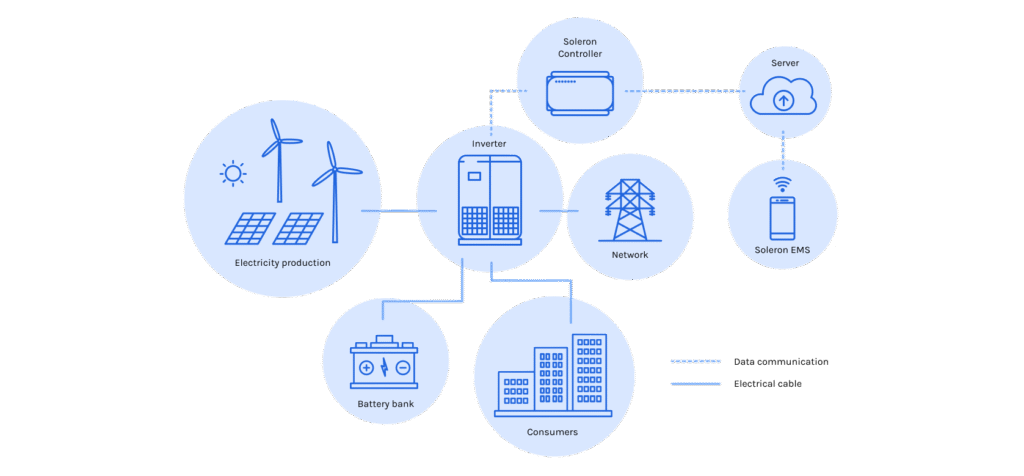
Smart energy storage optimizes costs year-round. During winter, batteries can charge at cheap nighttime exchange rates and discharge during daytime price peaks. This strategy smooths out consumption spikes and directly reduces monthly capacity fees. Additionally, a battery system improves internal voltage quality, helps manage reactive energy, and protects the facility from grid overloads.
Budgeting for the Future
The current geopolitical situation brings significant uncertainty. In our region, peak loads are often covered by starting up gas plants, which directly inflates the Nord Pool price level due to marginal pricing principles. Locking in a long-term, fixed electricity rate is only a temporary patch for a structural problem.
It makes much more financial sense to invest the money you would pay in risk margins directly into your own infrastructure. Building a solar plant or wind turbine, paired with optimal battery storage, pays off faster than ever in today’s volatile market.
Soleron helps businesses plan and implement comprehensive energy solutions, ensuring your fixed costs stay under long-term control.